dormant not dead
what can I say?

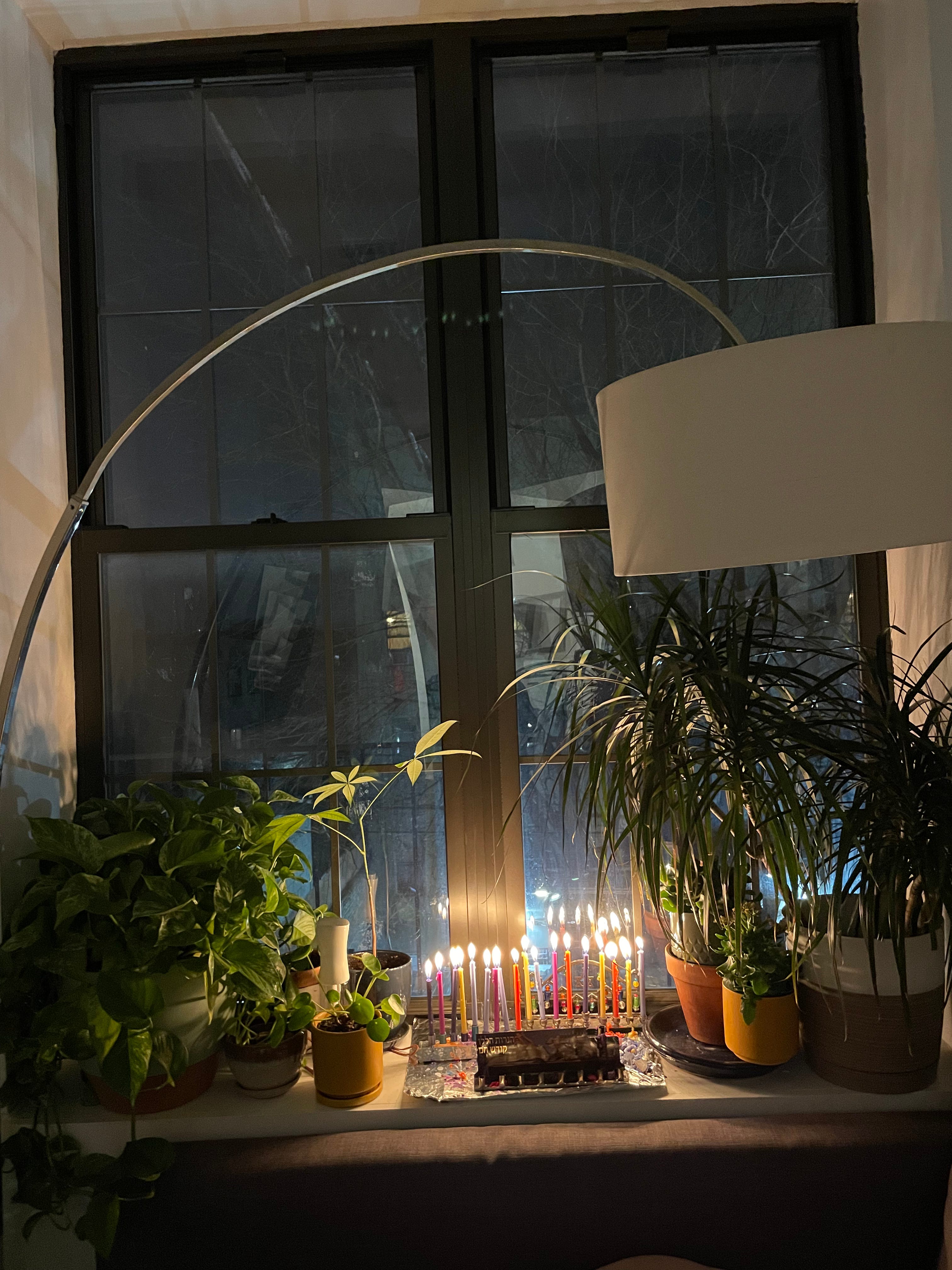
On the third night of Chanukah my roommates were both away. Unlike other Jewish rituals, lighting Chanukah candles does not require any quorum or community. It is a ritual with boundaries sensitive to time and space and mechanics and height— but funnily enough, not a collective. Yet, it felt wrong to light alone— inappropriate almost— in a way I can’t quite quantify or grasp. It felt stunningly lonely, the way a big city can shrink shrink shrink you if you aren’t growing. I said the blessing, whispering the melody aloud. Quickly. I wasn’t sure who was listening.
I lit the candles, their flickering reflection in my window beautiful, but in a cliche, overly-romantic sort of way. They almost make me sentimental.
—
My mother called me yesterday and asked if this newsletter was dead. Well, she called me to ask about my day and tell me about the vegan restaurant she ate at and to ask if my newsletter was behind me. We were talking about it today. About how you’re a very talented writer, and you haven’t written anything in a while.
I haven’t written anything in a while because I have nothing to say. Nothing to say in the face of such great, deep pain. I have nothing to say that has not already been said, no words to reflect the great tragedy of our world, of my people, of the land, and the ongoing cries, ongoing grief, and ongoing suffering. Ongoing, cyclical, constant. It never seems to end, does not seem to see an end or a path or a limit. There have been other people’s words: politicians, institutions, movements, countries. There have been protests statements marches condemnations retractions and so many words from so many people. What could I possibly say?
—
Nigunim come to me now. This is very new. I am not a musical person, the kind that never knows chords or keys or the right way to harmonize. But these melodies come to me and I can’t stop humming them. If I resist them, they trench harder.
Ya da dai dai dai dai ya da dai dai dai dai……
Nigunim are wordless melodies. Each one has an origin story, a tone, a emotion. Some are fast, some slow. Traditionally they are sung without harmonies or soloists. Just the same over and over and over again.
I am anxious always, but a nigun has great power, overcoming the mountains of neural pathways that forever antagonize. Temporary relief the melody brings, sometimes for seconds or even minutes. I know they are trying to tell me something, compel me somewhere. Reveal push or assure. Maybe They are trying. The message remains scrambled, uncertain, unresolved. I do not think I am being a good listener.
—
A good friend’s mom told her who told me that there are different kinds of stretch. We all should stretch sometimes; it’s what helps us grow, change, and expand. We can’t get too comfortable, only staying within the usual. But sometimes the stretch is past our healthy limits. It’s too far, too much, too exhaustive. That’s where it can get dangerous.
This newsletter was dormant not dead. I haven’t been stretching myself to write, even though I see writing as a beautiful and liberatory creative act. I have so many excuses; all legitimate, none sufficient. Creative work always tows a stretchy tightrope: each time I force myself to do it, I risk the process devolving into a resentful act. This is a fraught game. I feel better when I do it, but I do not want to, my brain plays out this internal conversation like an avoidant toddler.
I slowly stretch the words out of my mind and onto the page and each time it feels like a release. Slowly, then all at once. It is holy, I think.
—
In 2023 I began to learn Talmud for the first time. Hannah— a chevruta and dear friend of mine— spent months traveling in Italy before joining me for my second semester of intensive yeshiva learning. Reflecting on her year of exciting travel and discovery, Hannah told me “I thought for sure I would spend my year abroad and meet someone and fall in love.” This did not happen, no big cosmic romance defined Hannah’s year (or mine for that matter). “Instead, I fell in love with Talmud,” she remarked. No sentiment better describes my own year of all day study in the the beit midrash. Every day I sat hunched over books that my people had studied for thousands of years and fell deeper and deeper in love.
I grew up understanding that Jewish laws were absolute. Jews pray three times a day, for example. But the Talmud is full of legal discussions and legitimate dissenting opinions. Is that third evening service, Maariv, really obligatory, the rabbis argue at length. The Talmud (Tractate Brachot) is inconclusive, I learned.
As a halachic Jew (or someone who strives to be one), this is almost distressing. Maariv is obligatory! It must be! It is a major feature of the Jewish day. How could this certain fact possibly be up for debate?
The rabbis of the Talmud seems comfortable with letting this debate lie for the subsequent generations to read. There were two legal possibilities— optional or obligatory— and the body of work seems okay with holding those contradictions simultaneously— without a firm ruling being made. It’s almost like the text throws its hands up and says: well, what do you think?
Of course, the later halachist writers are the ones who really chose that the evening service will be obligatory after all. Someone had to choose, as living in between is a really hard way to practice.
—
Ya da dai dai dai dai ya da dai dai dai dai ya da dai dai dai dai ya da dai dai dai dai
—
I went to an exceptional yoga class on New Years’ Eve. The teacher asked us what is something constant we are bringing with us into the new year, something we know will remain. Of course I thought of Torah, but I also thought of my God. The God I have found through Torah. A compassionate, encompassing, creating, enduring, crying God.
It is a God that challenges me, exhausts me, pressures me, demands me, and angers me. A God that inspires Torah that is just and sensitive and humanitarian and universally sacred.
This is not the world I dream of. It isn’t the world She dreams of either.
—
I’m still not sure who I was whispering to.