winding down
one month left

Endings are hard. Anything I write-- one of these newsletter posts, an email, a journal entry, a personal bio--, I struggle to conclude. There is always more that could be said, never a perfect way to tie up all my themes and questions just neatly enough without being excessively trite or tidy or predictable. I struggle with finality, accepting that after that final sentence, I surrender control, the narrative I carefully crafted morphs beyond my written words. It all makes sense, really; I love control. I love to make sure my challah is perfectly braided and my garnishes spread out just right so donteventhink about asking what you can bring to my house for Shabbat because I’d prefer to make it myself. Thank! You! Very! Much! I spend too much time writing endings, trying to get them just right, inducing the perfect landing. I am hyper aware that when I type that last period or exclamation or question mark, when I declare “done”-- I am relinquishing control. The conclusion my readers’ will latch onto, the way they will shift my words to file into their own existing cognitive frameworks, will lead them to meaning or messages or value-- or not.
*
My year in Jerusalem is ending and endings are hard. My overly nostalgic self is constantly conscious of all the upcoming lasts. There will be a last day, a last Shabbat, a last meal, a last walk to class. Last conversations, last laughs, last arguments. They are coming; or, maybe, they are already here. It becomes almost romantic when you are looking for pastoral endings, a rosy gloss that can make all the harder, realer stuff melt into flecks of inconvenient dust. These are usually the images that get codified in my memory, idyllic landscapes and portraits of affirmative positivity. They are partly real.
The old adage tells me all good things must come to an end. Boo.
*
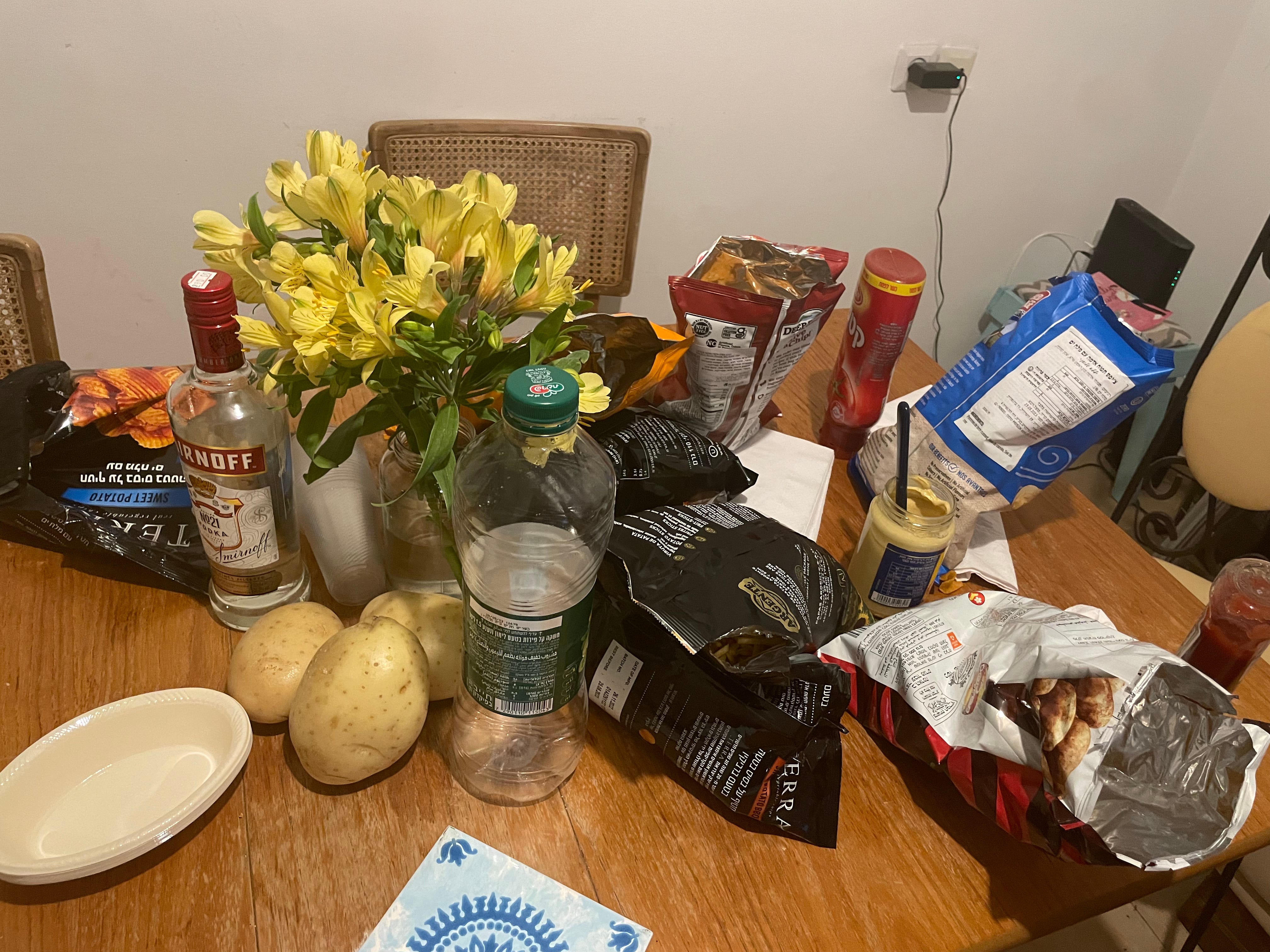
Last week sixteen of my friends crammed into my living room to eat potatoes and watch the new Netflix matchmaking series. The gathering was ridiculous and silly and wonderful and fun. There were latkes! And gnocchi! Many potato chips! We talked about a lot less serious things than we usually do, grateful to have a break from the consequential big questions we spend all day pondering. Commentary and hypotheses interjected the reality TV show, no one taking any of it too seriously. Our eyes collectively rolled at the cringey sayings of the matchmaker. Favorite characters were declared and season predictions were forecasted.
There will always be a part of me that is surprised when people actually show up when I invite them, the part of me that spirals in the eternal minutes before the first arrival knocks on the door. The intrusive what if no one comes? always looms. But people came, they indulged me, embracing my themed antics. And as I sat on my floor in the darkness, eyes focused on my computer screen-- a screen certainly not big enough nor loud enough for a crowd of this size-- I suddenly became overwhelmed with blessing.
You know those moments that are so wonderful and beautiful and memorable that you wish you could bottle them up and hold onto them forever? Those moments in which life is so epic and sublime that you cannot believe that this is really your life? I am fortunate to have had many of these over the past year, the moments in which every disgusting cliche about beautiful community and beautiful people feels startlingly precise. It was one of those.
*
Two weeks ago I decided I was ready to go home. It was enough, I decided. Everything and everyone was annoying me, angering me; I felt as if I had reached all my limits. I skipped class and cried in the park.
I think maybe sometimes when we reach the end of an experience we start to feel a lot of grief as we face the end of this really great thing. And instead of dealing with or processing that grief, it can just be easier to say that we are done and want to leave, to take an easy out, a wise friend soothes me as I lay in the grass. I ignore her but I know she is right.
*
Sometimes I have my father, the grammarian, edit my writing. We spar in the Google Docs comments and suggestions; him always advocating cutting and concision, me attached to flowery run on sentences with too many adjectives and that poke at the rules of the English language. He likes topic sentences, I use incomplete fragments. He tallies how many edits I accept and how many I reject. It is almost a game, how far we can push each other with the edits.
If my father had his way, all written endings would be summaries, restating the thesis reinforced throughout the essay. I do not write this way. I will never list morals, objectives, conclusions that I want my reader to know. I imagine my father on the other side of the world hunched in front of his computer, rolling his eyes at all my attempts of artistry, too vague for the businessman.
My favorite writing professor told me once to try and forgo withholding information from my readers. Sometimes we think we need to have a surprise or a twist, he suggests, but see what can happen when you let out the secret early on in the piece. Shock value can be cheap.
It doesn’t always have to come at the end, he says.
*
I am so lucky because my year has been so sacred. It’s been the buzz of the Beit Midrash. The smells of Friday afternoons. The flowers lining the streets. The hallway hellos. The lunches in the park. The friends. The hugs. Sentimentality makes endings harder and cringier, I know. But then suddenly you find yourself at Shabbat dinner with people you love so so much talking about how much you love each other and you sit back just for a moment to say I really am going to miss this.
And sometimes I wonder if things will ever be this great again, that this year of personal development and expansion is the best it will ever be. That there has been too much good; I am waiting for the catch. If not in this chapter, then certainly in the next.
*
There is never a perfect ending; endings are hard. I know this as a writer and as a human. There is no satisfactory way to tie up every loose end, no way to softly let go. No amount of editing, no amount of control, creates a flawless release. I definitely prefer beginnings.
Endings are also beginnings though, this is cliche and oversaid, but it is true. Growth begins in negative space, I’ve learned, the white space at the end of the page. The next is not new, at least not completely. Only a new paragraph, page break, chapter in our messy beautiful imperfect story.
*
(picture of Potato Party aftermath)
One door closes... Another door opens
We look forward to seeing you in the states and all that you've learned and all that you've loved.